






A man stood next to me the other day, filling his truck. He watched the numbers spin and shook his head.
“Almost $180,” he said. “A few months back, the same fill was about $140.” Forty dollars more for the same tank.
He runs on diesel. Most of us don’t. And that is exactly why this story slips right past us.
We watch the gasoline signs because that is the fuel we put in our cars. Diesel is the fuel we don’t buy — so we treat its price as somebody else’s problem.
It isn’t.
Diesel is the fuel of commerce. Trucks carry about two-thirds of the freight moved within the United States by weight, and about three-quarters by value. Diesel also powers trains, ships, farm equipment and construction machinery.
The food on your shelf, the medicine at your pharmacy, the lumber used to build a house and the package on your porch all depend, somewhere along the way, on diesel-powered transportation or equipment.
So, when diesel jumps, the bill doesn’t stop with the trucker. It eventually shows up at the farm, the lumberyard, the warehouse and the grocery store — quietly, sometimes weeks behind the truck.
Here is the number worth knowing.
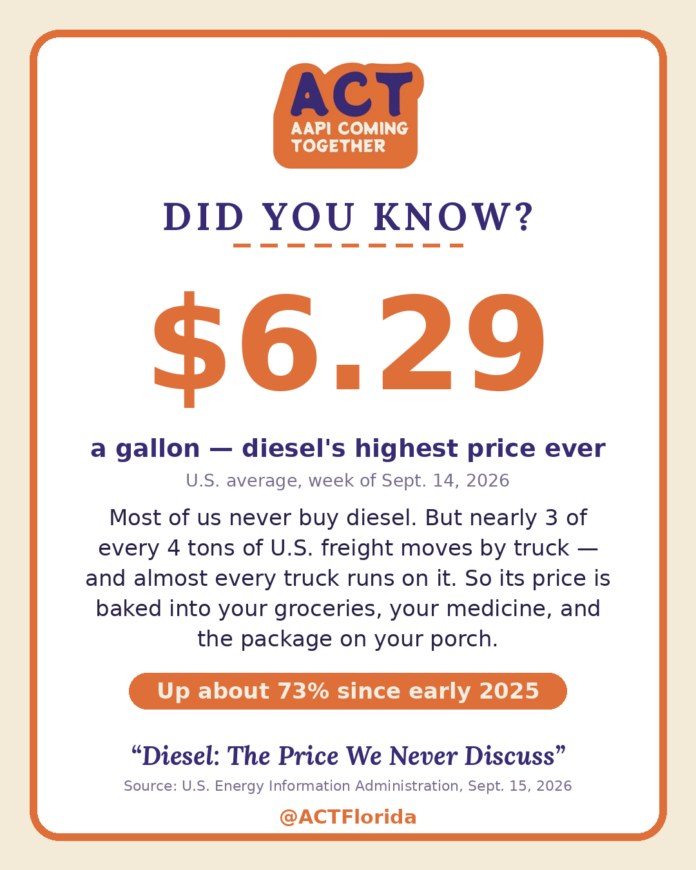
In mid-September 2026, the national average for diesel reached $6.29 a gallon — a record high. Regular gasoline was about $4.32. That is nearly a $2 difference. And since early 2025, diesel prices have risen by about 73 percent. Gasoline gets the headlines. Diesel is doing the quiet damage.
It is tempting to look for someone close to home to blame. But this isn’t simply a story about America failing to make enough fuel.
U.S. refineries are running hard. Through August, the country was producing more distillate fuel — the category that includes diesel — than in any year since 2019. The problem is bigger than us.
Refinery disruptions overseas, reduced exports from some countries and strong global demand have tightened the world’s supply of diesel and other distillate fuels. And the United States exports a significant amount of diesel to foreign buyers.
This is a global squeeze. There is no simple switch to flip at home. And don’t expect the pressure to disappear overnight.
U.S. distillate inventories are on track to fall below 100 million barrels this fall — the lowest level since 2003 — and are expected to stay below their five-year low for much of 2027. When inventories are thin, there is little cushion when another refinery goes down, a shipping route is disrupted, or global demand suddenly rises.
There is another complication.
Diesel and home heating oil are both distillate fuels made during the refining process. As winter approaches, freight trucks and heating systems will be drawing on the same limited pool of fuel. That can put additional pressure on prices.
This is the hidden cost of 2026. It is not a line on your pay stub or a separate bill in your mailbox. Just a little more in the price of milk, lumber, food, medicine and the countless other things that have to be moved before they reach us.
We tend to think of fuel as something we put in our cars. But some fuel never goes into our cars. It goes into the trucks, trains, ships, tractors and machines that make the economy move.
So, watch the diesel number the way you watch the gasoline sign. The trucker sees the cost immediately. The farmer sees it in the cost of planting and harvesting. The store eventually sees it in the cost of getting products onto the shelves.
And the rest of us see it when we pay the bill.
Diesel is the fuel we don’t buy. But in one way or another, we all pay for it.
Kam Shenai is a retired executive and civic leader in Lake Nona and co-founder of AAPI Coming Together (ACT Florida), a nonpartisan civic-participation group in Central Florida.