



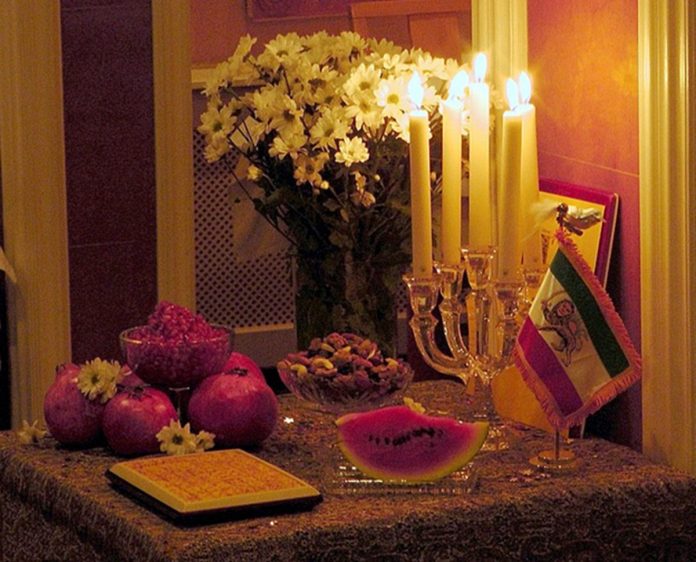

This week millions of Iranic peoples and people of related ethnic groups will be celebrating the longest night of the year – the winter solstice. The celebration in Farsi is referred to as Shab-e Yalda or Shab-e Chelleh.
The term “Yalda” comes from the Syriac language’s word for “birth”, alternatively the term “Chelleh” comes from the Arabic language’s word “Khalwa” referring to the Sufi tradition of self-seclusion in prayer and meditation for 40 days (not to be confused with the Islamic funeral rite “Iddah” for widows which lasts for 4 months 10 days). Both these names have a vague relationship with the holiday itself (i.e both Khalwa and the harshest part of the winter season are 40 days) but serve as a linguistic testimony to the dynamic history of Persia and its relationship to its neighboring cultures.
Yalda’s origins are in the Zoroastrian faith (the pre-Islamic religion of Persia), in which families and friends would stay awake in one another’s company with the belief that being together offered protection from the evil spirit Ahriman who was said to have been in an empowered state during the longest night of the year. The Islamic faith itself does not claim Yalda, hence today the celebration of the winter solstice is generally regarded as a cultural celebration rather than a religious one among Persian and other Muslim groups from Iranic regions.
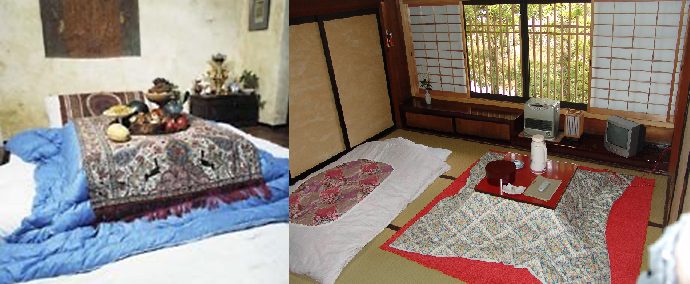
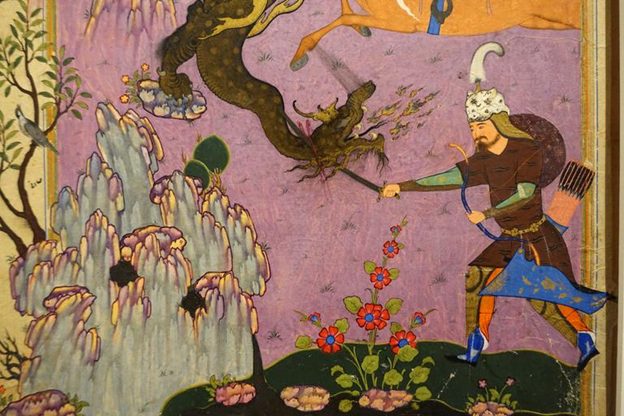
Yalda festivities often involve households gathering around a Korsi (a word derived from Arabic meaning “Chair”) which is a heated floor table very similar to the Japanese Kotatsu. Several fruits deemed auspicious for the evening such as pomegranates, khormaloo (persimmon) and watermelon are eaten throughout the night as family and friends recite poetry from various Persian epics such as the Divan-e-Hafez (Hafez’s book of poems) or Ferdowsi’s Shahnameh (Book of Kings).
Similar celebrations are observed in Syria, Iraq, and Turkey in the Kurdistan region as well as in parts of Central and South Asia, in Kashmir for example the harshest 40 days of winter are referred to as Chillai Kalan and are believed to have inherited this designation from Kashmir’s historic ties to Persia.
Even if one does not celebrate Yalda, it can be appreciated as a living example of how culture evolves, and how the good company of family and friends can help us weather even the coldest and darkest of nights.
Happy holidays everyone, celebrate responsibly!